Two PS2 Bangers Turn 20
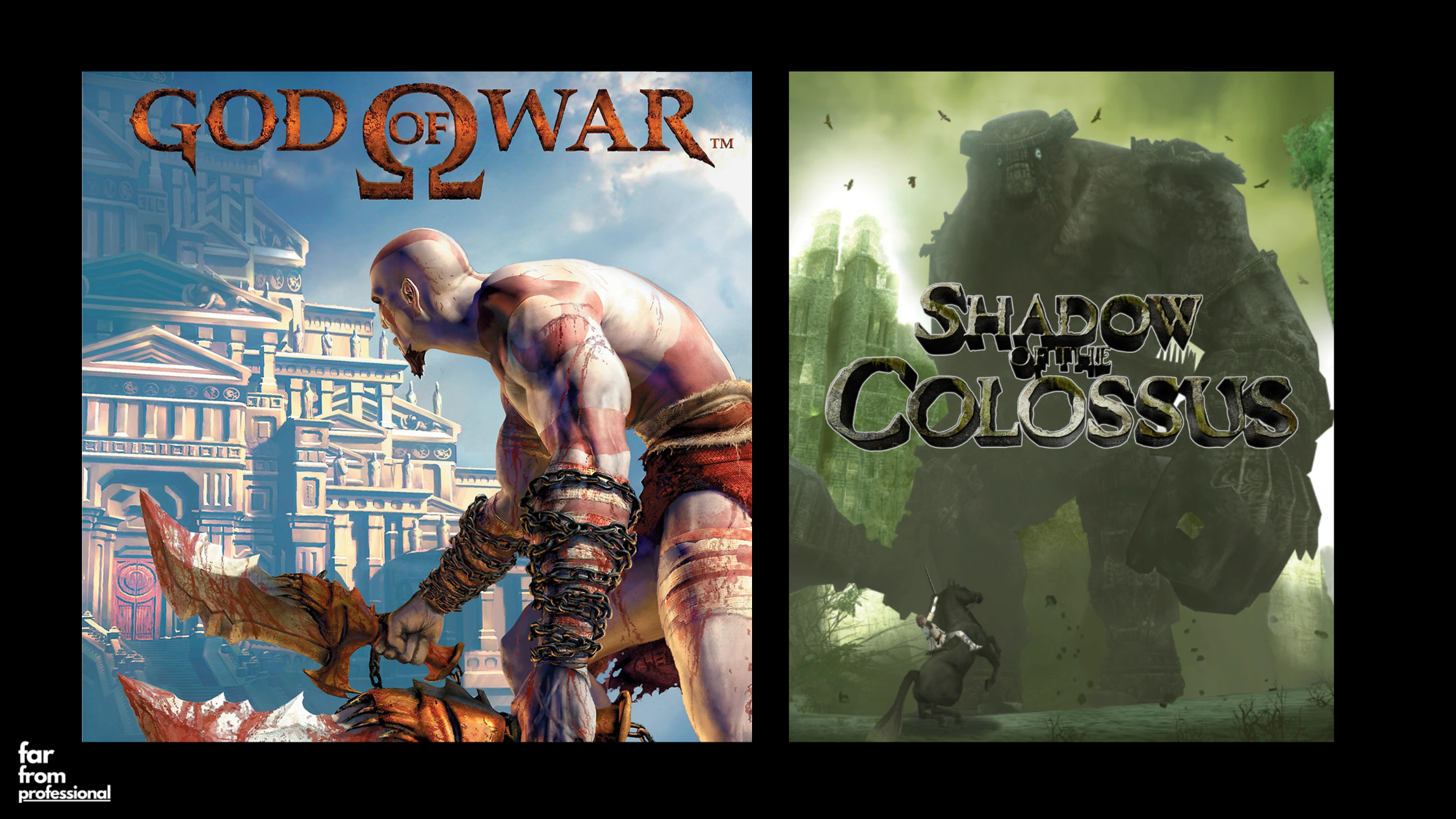
God of War and Shadow of the Colossus (2005)
These video games got me through 2005.
When I was growing up in the 80s and 90s, the video game console revolutionized home entertainment. With each new generation of console that was released during that span of time and into the 2000s, video game developers were able to create more immersive experiences, and players were able to lose themselves in the fun of playing as Link or James Bond, or going toe-to-toe with Mike Tyson or Sub-Zero. As the popularity of video games grew, so did the belief that they were doing damage to the children who played them and to society at large. They were blamed for violent and immoral behavior because some violent and immoral people liked to play them. Detractors cherry picked examples to serve as representations of the entire group of gamers worldwide. It didn’t work then, and now people make their living off video game streaming. The games themselves have continued to transform storytelling and entertainment, and psychological research on the benefits of playing video games has been written. By the mid-2000s, games had shifted to offer players cognitive, emotional, and social benefits. It was in the middle of this era that two games served me in therapeutic ways.
Twenty years ago, I was in my early 20’s and in a difficult season of my life. I hadn’t yet found my strength in faith. It was being pushed to my limits, and I was relenting to the wrong choice at every opportunity I had to make the right one. Balancing work and school while living on my own, in the midst of a mentally destructive relationship, proved to be more than I could handle. I was a terrible college student and a bad friend, which only compounded my sense of overall failure. I distanced myself from my family. I was already disconnected from God. Things were not feeling great for me back on that endless loop of work and school and stress and tension, worrying about grades and bills and what other people were up to late at night when I couldn’t fall asleep. Yuck. I don’t like to look back on 2005 because of the shame it stirs in me, but there were a couple of bright spots for me that year. Two video games were released, and these games were the healthy escapism I needed to keep myself distracted from my self-loathing and destructive lifestyle.
God of War
In March of 2005, Santa Monica Studios released God of War on PlayStation 2. It is an action adventure game steeped in Greek mythology and drenched in the blood of the hero's enemies. That hero, Kratos, was in many ways an anti-hero. He was driven by his sense of duty and his pride, which made him vulnerable. When Kratos was at the brink of defeat, he begged the Greek God of War, Ares, to save his life. In exchange, Kratos would dedicate his life to serve Ares. He agrees to Kratos’ terms, and Kratos goes on to vanquish his enemies on the battlefield. However, Ares tricked Kratos into murdering his own family because Ares wanted Kratos to become his perfect warrior. To become that, Ares believed that Kratos had to sever all ties with his humanity, so he had to get rid of Kratos’ daughter and wife. All of that happens in the game’s prologue. When you take your first playable steps as Kratos, his is already on his path of vengeance.
That blood-soaked path is filled with macabre scenes, terrifying monsters, and deadly puzzles. The fast-paced action was complimented by graphics that stretched the PS2 to its performance limits, and it changed the way future games utilized fixed, cinematic cameras and designed their combat systems. Its narrative and technical achievements earned it numerous awards, including “Game of the Year”, and its success bore sequels and prequels, some of which were vast improvements on the original game. If you have played any of these games, you know what I’m talking about.
God of War got me through the darkness of sorrow-filled spring by simply providing me with a world I could slip into and become the hero, and not just any old hero, but one with a shameful past and painful regrets. Relatable. I knew what that was like, but I wasn’t going to go about seeking vengeance to solve my problems. That’s what Kratos did. Gifted with god-like strength and the Spartan spirit, he tore through armies of ghoulish enemies across the mythological landscape on his way to killing Ares. I could only get a taste of that adventure by playing God of War.
Every night, I exercised my own demons as Kratos. It helped me decompress after a long day of school or work or both. It helped me keep my head clear of crazy thoughts. It drove away the specter of failure, if only temporarily. By the beginning of the summer of 2005, I had wrapped up the story. I had nothing to do with my idle hand but get into trouble over the summer. Then, in October, another game that came out that helped me get through the last third of a crappy year.
Shadow of the Colossus
In the fall of 2005, months after God of War was released, Japan Studio and Team Ico released Shadow of the Colossus, my all-time favorite video game, and I have played a ton of bangers. Off the rip, here are my top ten:
Shadow of the Colossus
Red Dead Redemption 2
The Witcher 3: Wild Hunt
Elder Scrolls: Skyrim
God of War 3
Metal Gear Solid 4: Guns of the Patriots
Uncharted 2: Among Thieves
Grand Theft Auto: San Andreas
The Legend of Zelda: The Ocarina of Time
Super Mario World
You can see what kind of games I gravitated towards: single-player, open-world, narrative-driven. Games that are typically described by using hyphenated words. Atop that remarkable list, Shadow of the Colossus reigns. From the moment the first notes of “Prologue: To the Ancient Land” break the silence and a hawk flies into view, I knew this wasn’t an everyday button masher. It is not even a typical video game; it is a work of art. God of War is a typical video game. There’s no nuance to it. It’s not multilayered in its production design and story, and that’s okay. It is s a straightforward action game that was made for a good time, and it delivered a damn good one. Colossus was made for a different kind of entertainment. My experience with this game was a meditative exploration of the Forbidden Land that flipped my expectations upside down by the time the final act closed.
I had no idea what to expect when I brought the game home. The cover art caught my eye, and what was supposed to be a casual stroll through GameStop before class one afternoon turned into one of the best purchases of my life.
Spoilers Ahead (you’ve had twenty years to play this game)
As the game’s central character Wander, you’re on a specific journey that takes you to a place you’re not supposed to go, with Mono, a dead woman that you desperately want to revive. The two of you ride into the Forbidden Land on your horse, Agro, sword in hand. You bring her to the Shrine of Worship and lay her on the shrine’s altar. A disembodied voice named Dormin then gives you instructions on how to save her soul. He tells you to let your sword guide you to the first of sixteen colossi that you’ll have to fight. Defeating all of them will save Mono, so you go ahead and do it. Later in the game, you (the player) learn that the sword Wander is carrying with him to defeat the colossi is the Ancient Sword, an artifact that was under security in his village. He stole it, and now the village shaman, Lord Emon, and some warriors are after him. Something about Wander’s quest suddenly feels perilous. Maybe the dark energy that is released from every fallen colossus, the one that then penetrates Wander’s body, is nefarious but not that bad. Turns out it is very much nefarious. Dormin has tricked Wander into using the sword to release the dark energy that is trapped within the colossi. The are the guardians of the Forbidden Land, protecting the humans who live beyond it.
Wander is a destructive force bent on completing a selfish quest even if it means the destruction of the world. It was a powerful plot twist on the same level of anagnorisis as the ending of The Sixth Sense. Before that reveal takes place, the game hits you with one of the more emotional moments in a video game that I have ever experienced when Agro falls. All of that had me thinking about my own life at that point. Maybe I was the villain who thought I was the hero. My behavior back then had me feeling like there was a better version of me being held prisoner by my ego. The game helped me transform that behavior back into a force of positivity. I consider this to be a little miracle in my life at a time I needed it most.
The music, the graphics, the game design are all top-notch, and they bring an aura to that incredible story. Wander only ever speaks his horse’s name and utters a few grunts when climbing, falling, or getting smacked by a colossus. There are no other enemies in the game to fight other than the colossi, and the game map is big. The developers had grand plans to fill this land with more giants, but it wasn’t in the cards. Still, Shadow of the Colossus took my breath away the first time I played it, which I slow-played through the holiday season, knocking off colossus number sixteen to ring in 2006. I was in no rush to get through the game because I needed an escape from some lonely nights. The Forbidden Land itself is vast and empty. The loneliness you feel playing as Wander, riding Agro through the Land truly makes it feel forbidden and foreboding, but it was comforting to wander through dense forests or sprint across a grassy plain. There’s a lot going on around Wander and Agro in a land that is without another single living human. It is a feast for eyes and ears. That part of the game was the calm before the storm of battle. There are mini-shrine spread out across the land that restore your health when you kneel and pray at them. I used them to repent for slaying a colossus, and the times I spent getting to one of them and then to the next colossus were exercises in staying present.
As with every other anniversary that passes me by, I can’t believe it has been twenty years since God of War and Shadow of the Colossus were released. Since 2005, these games have been remastered, and the new versions look and play fantastic. If you are a young gamer and have never played these games, or perhaps an older gamer who slept on them, check them out. They are wildly different experiences, but they might just get you through a rough season in your life and teach you something about yourself.